
Getting the measurements right before ordering matters just as much as selecting the style. Available patio space, furniture placement, walking clearance, and the relationship between the house and surrounding features all influence whether a structure will feel comfortable once installed. Careful planning can make patio pergola installation much more straightforward, while SUNJOY offers pergola designs in different sizes and configurations, giving homeowners practical examples to compare when planning an existing patio.
Begin With The Usable Patio Area
Start by measuring the section where the structure is actually intended to stand rather than relying on the total size of the patio. Record the length and width at several points, especially if the surface has an irregular shape. Differences between measurements may reveal corners, projections, or other obstacles that need to be considered before choosing a kit.
Next, identify fixed features around the proposed location. Exterior walls, doors, steps, railings, grills, outdoor kitchens, lighting fixtures, and drainage outlets can all affect the usable footprint. Marking these elements on a simple sketch provides a clearer picture than measurements alone.
Height deserves equal attention. Measure from the patio surface to nearby eaves, balconies, windows, or overhead branches. An outdoor pergola needs sufficient vertical space for its posts, canopy, and other components while leaving practical clearance from surrounding features.
Measure For Furniture And Movement
The structure’s footprint does not represent the entire area required for comfortable use. Dining chairs need space to move, lounge furniture requires circulation around seating, and pathways should remain accessible. Measuring the intended furniture before finalizing the layout can prevent a structure from consuming more usable space than expected.
Consider how people will enter and leave the area. A direct route from an exterior door may be more valuable than maximizing the covered footprint. High-traffic paths should remain unobstructed, particularly around kitchens, pools, garages, and garden entrances.
Furniture can also help determine orientation. A rectangular seating arrangement may work better with the longer side aligned parallel to the house, while another layout could benefit from turning the structure ninety degrees. These decisions should be made on the ground before posts are installed rather than after assembly begins.
Account For Ground Conditions And Boundaries
Measurements should include the actual mounting surface. Concrete slabs, pavers, wooden decks, and other patio materials may require different anchoring approaches, so the available installation area needs to be checked against the manufacturer’s instructions.
Property boundaries create another practical limit. Fences, neighboring buildings, utility equipment, and access paths may restrict where posts can be positioned. Local building requirements should also be reviewed because setback rules and permit requirements differ between jurisdictions.
The patio surface should also be checked for levelness. Place a long level across several points of the patio to identify noticeable slopes or changes in elevation. Surface levelness and mounting conditions can affect post placement and assembly, so the site should be checked before purchasing an outdoor pergola.
Match Measurements To The Kit
Product dimensions should be compared with the measured patio rather than viewed in isolation. Check the listed overall length and width, then consider where the posts will sit within that footprint. Interior usable space can differ from the outside dimensions because structural members occupy part of the area.
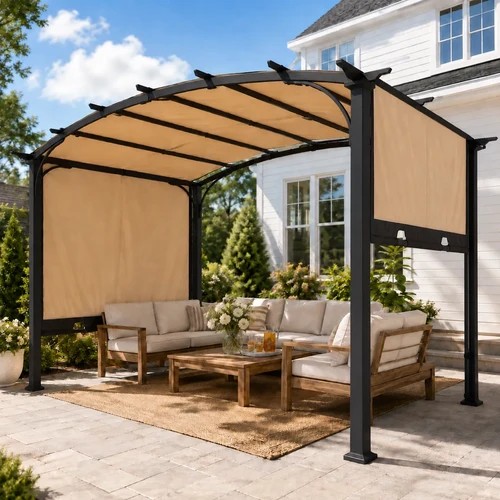
The Arcadia Adjustable Arched Pergola, 9×11 provides one example of why product-specific information matters. The model has an overall size of 10.8 ft. L × 8.9 ft. W × 7.8 ft. H, a base size of 9.8 ft. × 7.9 ft., and an interior post-to-post size of 9.5 ft. × 7.5 ft., showing why product specifications should be compared with the measured patio area.
Canopy movement also deserves attention. An adjustable covering may change the way shade reaches furniture and nearby walls during different parts of the day. Leave sufficient surrounding space for normal operation and maintenance, following the manufacturer’s assembly guidance.
Verify The Layout Before Installation
Once the proposed dimensions have been selected, mark the footprint directly on the patio. Painter’s tape, chalk, or temporary markers can show where the posts and outer edges will sit. Walking through the marked area often reveals spacing problems that are difficult to notice on paper.
Double-check the measurements against the product specification before ordering. Length, width, height, post spacing, and any required clearance should all be reviewed. Relying on a single measurement can create avoidable errors, particularly on patios with unusual shapes.
Consider future changes before fixing the location. New planters, outdoor lighting, seating, grills, or privacy screens may eventually occupy the same area. Leaving practical access around the installation can make later improvements easier and preserve the functionality of the space.
Conclusion
Good measurement goes beyond finding two numbers for length and width. The most useful assessment combines the patio’s physical boundaries with furniture requirements, circulation, mounting conditions, overhead clearance, and the specifications of the selected kit. Careful preparation gives homeowners a stronger basis for evaluating Patio pergola options and reduces surprises during assembly.
Once those measurements have been checked against the product documentation, an outdoor pergola can be positioned with greater confidence while keeping the surrounding yard practical. With its focus on outdoor-living solutions, SUNJOY provides examples of how thoughtful dimensions, adaptable canopies, and durable materials can work together within everyday backyard spaces.
